Keeping the water in your garden pond clear and healthy is not just this pleasing to the eyeit is too essential for the well-being of its inhabitants.
An effective filter system plays an essential role removing debris, toxins and harmful microorganisms.
Without proper filtration, water can quickly become cloudy and unhealthy, putting aquatic life at risk.
In this article I will walk you through the key steps to choose the right filter.
We will address the selection criteriasuch as the size and population of your catchment.
Then I'll introduce you the different types of filters availableto help you make the right choice for your aquatic design.
 choose-a-garden-pond-filter-the-complete-guide.jpg" data-link-wrap="true" data-width="800" data-height="533" data-css="tve-u-192b486acf4" style="--smush-placeholder-width: 800px; --smush-placeholder-aspect-ratio: 800/533;aspect-ratio: auto 1024 / 683;" data-tcb-events="__TCB_EVENT_[{"t":"click","a":"thrive_zoom","config":{"id":"13199","size":"full"}}]_TNEVE_BCT__" data-/>
The criteria for choosing a pond filter
Choosing a pond filter can seem confusing with so many options, but understanding the essential criteria makes this process easier.
These criteria help you select a filtration system that is perfectly suited to the size, type of your pond and its inhabitants..
The size of the pelvis
To choose the appropriate filter, the first step is to calculate the volume of your pool.
For a rectangular body of waterthis is done simply by multiplying the length, width and depth.
For a swimming pool with a non-geometric shapewe can estimate its volume by dividing it into several rectangles or squares. Calculate the volume of each rectangle by multiplying the average length, width and depth.
A more accurate method is to use your water meter. Before filling the tub, note the reading of the general water meter. Once filled, compare this reading to the new one to get the exact volume of water used.
The size of your pond determines the filtration capacity needed. A large water feature requires a filter with a higher filtration capacity to ensure effective removal of debris and organic waste.
We will see immediately afterwards that the population of your pond also plays a fundamental role in the sizing of the filter.
 garden-pond-filter-the-complete-guide.jpg" data-link-wrap="true" data-width="800" data-height="534" data-css="tve-u-192b486acf4" style="--smush-placeholder-width: 800px; --smush-placeholder-aspect-ratio: 800/534;aspect-ratio: auto 1024 / 683;" data-tcb-events="__TCB_EVENT_[{"t":"click","a":"thrive_zoom","config":{"id":"13238","size":"full"}}]_TNEVE_BCT__" data-/>
The population of the basin
The population of the basin directly influences the choice of filter.
A Purely decorative water featurewithout fish, requires less filtration.
If you introduce some fish, even the low-impact species are popular goldfishit is essential to opt for a more efficient filter. Generally, their presence halves the filtration capacity of a system.
When koi carp are added, the need for filtration increases further.
Due to the significant waste they produce, a body of water with koi carp divides the filtration capacity by two times compared to standard fish.
Therefore, it is generally considered soa filter capable of handling 20 m³ of water in a decorative pond would only be suitable for 10 m³ with normal fish and 5 m³ with koi.
Knowing if you will put fish and what type is therefore essential to evaluate the necessary filtering device.
 garden-pond-filter-the-complete-guide.png" data-link-wrap="true" data-width="999" data-height="349" data-tcb-events="__TCB_EVENT_[{"t":"click","a":"thrive_zoom","config":{"id":"13190","size":"full"}}]_TNEVE_BCT__" data-css="tve-u-192b4420e01" style="--smush-placeholder-width: 999px; --smush-placeholder-aspect-ratio: 999/349;aspect-ratio: auto 999 / 349;" data-/>
Example of a technical data sheet for a range of filters. We see that the capacity of each filter is different depending on whether the pond is without fish, with fish or with koi ©Oase
The different types of pond filters
Exists different filtering technologieseach of which meets specific needs.
For each technology I will illustrate in detail how it works, which type of pool it is ideal for, where to install it and its maintenance needs.
With this information, you will be able to choose the filtration system that will best meet your expectations and those of your body of water.
The submerged filter
 garden-pond-filter-the-complete-guide.png" data-link-wrap="true" data-width="690" data-height="484" data-tcb-events="__TCB_EVENT_[{"t":"click","a":"thrive_zoom","config":{"id":"13194","size":"full"}}]_TNEVE_BCT__" data-css="tve-u-192b45f06cf" style="--smush-placeholder-width: 690px; --smush-placeholder-aspect-ratio: 690/484;aspect-ratio: auto 690 / 484;" data-/>
Operation diagram of the submerged filter ©Oase
The submerged filter is thick integrated into a pump and it is positioned directly into the water.
There is compact system offers numerous advantages: it is discreet, easy to install and its cost is generally low. However, its capacity is limited, which makes it ideal for small ponds. The most powerful models are suitable for up to 9 m³ without fish or 4 m³ with fish.
In terms of maintenance, the submersible filter requires regular cleaning to avoid blockages and maintain optimal efficiency. Filter sponges must be rinsed to ensure trouble-free operation.
 garden-pond-filter-the-complete-guide.jpg" data-link-wrap="true" data-width="350" data-height="503" style="--smush-placeholder-width: 350px; --smush-placeholder-aspect-ratio: 350/503;aspect-ratio: auto 713 / 1024;" data-css="tve-u-192b4a7df8a" data-tcb-events="__TCB_EVENT_[{"t":"click","a":"thrive_zoom","config":{"id":"13222","size":"full"}}]_TNEVE_BCT__" data-/>
Example of submerged filter ©Oase
Discover the submersible filter models available on:
Amazon
The pressure filter
 garden-pond-filter-the-complete-guide.png" data-link-wrap="true" data-width="500" data-height="399" data-css="tve-u-192b45f22f7" style="--smush-placeholder-width: 500px; --smush-placeholder-aspect-ratio: 500/399;aspect-ratio: auto 592 / 472;" data-tcb-events="__TCB_EVENT_[{"t":"click","a":"thrive_zoom","config":{"id":"13196","size":"full"}}]_TNEVE_BCT__" data-/>
Operation diagram of the pressure filter ©Oase
The pressure filter works in pushing water through various filter materialsthus ensuring thorough filtration.
It often incorporates a UV clarifier to eliminate the microorganisms responsible for green water.
This filter offers high performance and is powerful enough to power the waterfallsthus adding an aesthetic touch to your pool.
However, this performance comes at a cost. The pressure filter is generally more expensive than other types of filters.
These filters are particularly suitable for medium sized poolssome models can handle up to 31 m³ without fish, 15 m³ with fish or 7.5 m³ with koi.
Their ability to keep water clear and healthy while powering aquatic facilities a popular choice for water garden enthusiasts.
AND regular cleaning it is essential to avoid blockages and ensure optimal efficiency. Maintenance involves rinse the filter elements and regular checking of the UV system.
 garden-pond-filter-the-complete-guide.jpg" data-link-wrap="true" data-width="350" data-height="365" style="--smush-placeholder-width: 350px; --smush-placeholder-aspect-ratio: 350/365;aspect-ratio: auto 981 / 1024;" data-css="tve-u-192b4a7df8a" data-tcb-events="__TCB_EVENT_[{"t":"click","a":"thrive_zoom","config":{"id":"13206","size":"full"}}]_TNEVE_BCT__" data-/>
Example of pressure filter ©SunSun
The gravitational filter
 garden-pond-filter-the-complete-guide.png" data-link-wrap="true" data-width="500" data-height="396" data-css="tve-u-192b45f22f7" style="--smush-placeholder-width: 500px; --smush-placeholder-aspect-ratio: 500/396;aspect-ratio: auto 571 / 452;" data-tcb-events="__TCB_EVENT_[{"t":"click","a":"thrive_zoom","config":{"id":"13193","size":"full"}}]_TNEVE_BCT__" data-/>
Operation diagram of the gravity filter ©Oase
The gravity filter works in letting the water pass through several layers of filter materials and then return to the pool by gravity.
This gentle but effective filtration process is particularly suitable for large ponds hosting koi carp..
Despite its advantages, the gravity filter can be cumbersome and requires a more complex installation, to allow the water to return by gravity.
This complexity and its dimensions mean thisit is not always suitable for small spaces or homeowners looking for a simple solution.
Ideal for large aquatic developments, there are gravity filter models that can handle up to 36m³ without fish, 18m³ with fish and 9m³ with koi, ensuring a stable and healthy ecosystem.
In terms of maintenance, these systems require the regular cleaning of filter materials.

Example of gravity filter ©Oase
Discover the gravity filter models available on:
Amazon
Works
The multi-camera filter
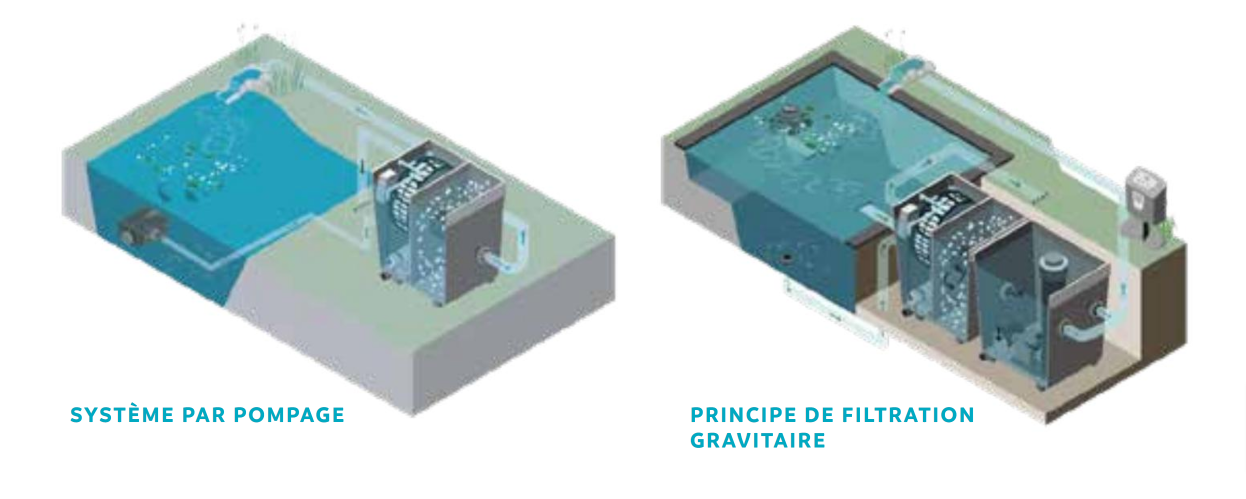
Operation diagram of the multi-camera filter ©Oase
The multi-chamber filter uses a system composed of multiple compartments, providing both mechanical and biological filtration. Each chamber is dedicated to a specific purification process, which helps optimize the efficiency of the system.
This filter can work by gravity or by pumpingthus offering greater installation flexibility compared to gravity filters.
The main advantage of the multi-camera filter lies in its ability to reach very complete filtration. It is particularly effective for large swimming pools with a high fish population, guaranteeing clear and healthy waters.
Larger models can handle up to 200m³ without fish or 100m³ with koi.
However, it is imposing size requires considerable space.
AND sustained maintenance it is necessary to maintain its effectiveness. This includes cleaning chambers and checking components for wear or blockages.
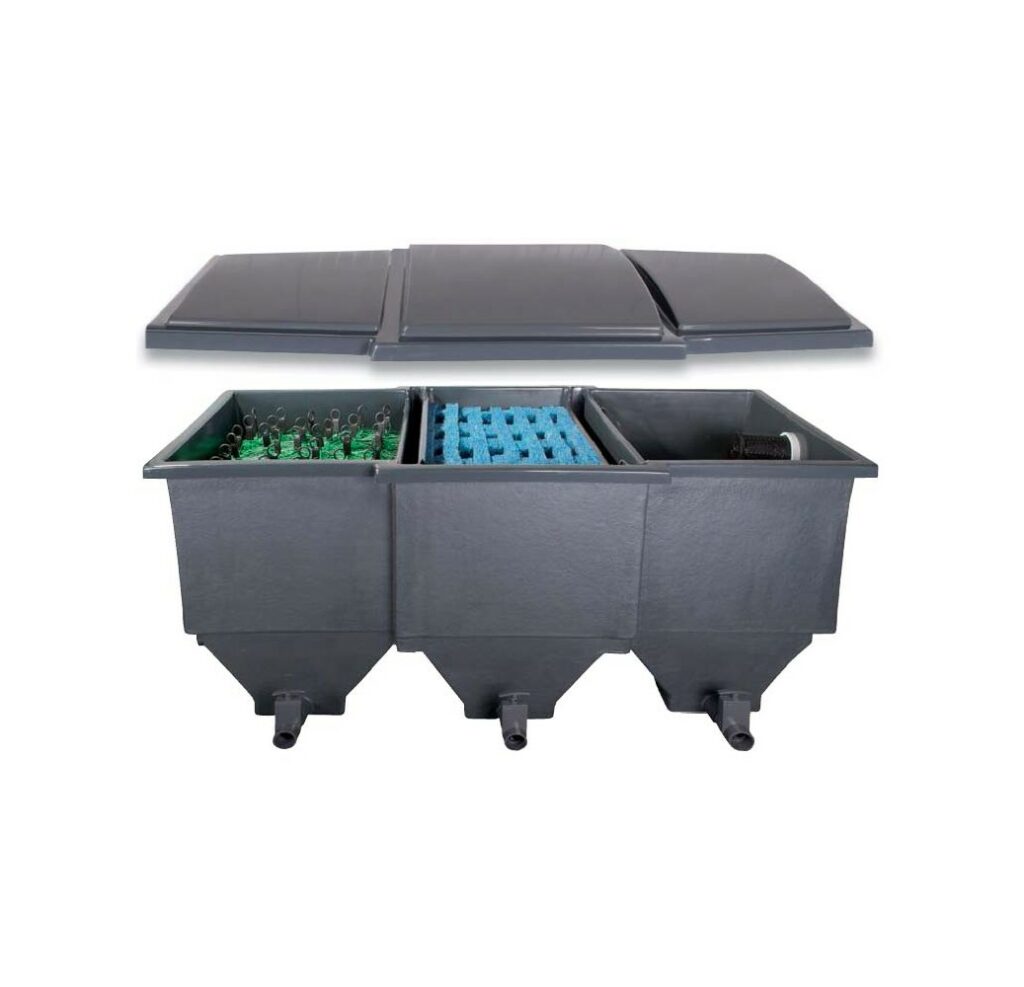
Example of a multi-camera filter ©SuperFish
Discover the multicamera filter models available on:
Amazon
Works
The drum filter

Operation diagram of the drum filter ©Oase
The drum filter is a automated system which stands out for its automatic cleaning mechanism. The water passes through a cylindrical sieve which captures impurities. As soon as the screen becomes clogged, automatic cleaning is activated, removing debris without manual intervention.
This filter offers the huge advantage of almost non-existent maintenance and a very high filtration efficiency. However, its cost is often higher than other systems, making it more suitable for large professional ponds (up to 140 m³ without fish) or owners who wish to minimize the maintenance required.
Maintenance of a drum filter is minimal and mostly limited to the occasional check of the automation to ensure the cleaning process is working properly.

Example of a drum filter ©Oase

To ensure clear and healthy water in your garden pond, choosing the right filter system is a crucial step.
Taking into account the specifics of your pond and the information provided in this guide, you are now ready to make the right choice and invest in a suitable filter that will ensure the longevity and health of your body of water.
Don't hesitate to do it share your feedback in the comments. Your opinion is valuable and could help other aquatic design enthusiasts adopt the ideal solution.
latest posts published

Guide to choosing the right size
Ideal ratio for a high performance engine

Easy installation and practical advantages

How to use sodium bisulfate in a swimming pool: dosage and precautions
Use it correctly for optimal maintenance

The best ideas for an elegant look

Advantages and limitations of this natural coating

How to choose and install your curtains

Materials and advice for better insulation