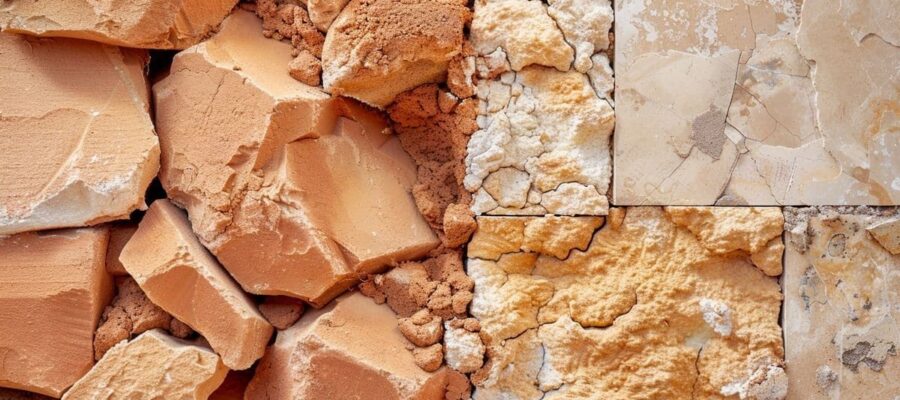
Clay construction is emerging as a sustainable alternative to traditional materials by combining them ecology et executive technique. This natural material, often associated with ancestral techniques, is gaining popularity thanks to its insulating properties and its low environmental impact. However, its use presents specific challenges, related in particular to the stability of clay soils and appropriate construction techniques.
The ecological advantages of clay buildings
Natural and renewable material
Clay, an important component of raw earthstands out for its local origin and his low carbon footprint. Unlike cement, whose production generates significant CO₂ emissions, clay requires little energy to transform. It is often extracted near construction sites, reducing transport and emissions related to the transport of materials.
Thermal and acoustic insulation
Offer clay houses natural insulation thanks to them thermal mass. The clay stores heat during the day and releases it at night, limiting the need for heating or air conditioning. This property is particularly suited to Mediterranean or continental climates. Furthermore, his thickness (often greater than 30 cm) reduces external noise, improving acoustic comfort.
Durability and minimal maintenance
Clay constructions are resistant to earthquakes thanks to them flexibility and to theirs moderate mass. Unlike rigid materials such as concrete, they absorb movement without cracking. Maintenance is also simplified: the clay does not require painting or chemical treatments, reducing maintenance costs in the long term.
Technical challenges and innovative solutions
Shrinkage-swelling: a big problem
Clayey soils suffer contraction-inflation cycles depending on the humidity. These movements can cause cracks in the foundations and walls, or even collapses in case of negligence. To limit these risks, preventive geotechnical studies are essential to evaluate the soil stability and adapt construction techniques.
Geogrids and resin injections: preventive and curative solutions
- Geogrids : Carpets inside polymer fibers (plastic or glass) are integrated into the foundations to reinforce the tensile strength from the ground. These structures also improve the drainageavoiding the accumulation of water under buildings.
- Resin injections : For existing buildings, expansive resins (epoxy or polyurethane) are injected under the foundations. They compact the soil and stabilize the structure, an effective solution against differential settlements.
Drainage and waterproofing: keys to sustainability
AND effective drainage around the house is essential to avoid saturation of the clay soil. Del French exhausts OR ditches allow the evacuation of rainwater, reducing the variations in humidity responsible for ground movements. THE'airtight the clay walls also limit infiltrations, preserving the integrity of the structure.
Integration into low carbon buildings

Low carbon concrete: a complementary alternative
THE low carbon concretelike the Rsoft range, combines recycled materials (recycled steel) e low carbon content formulations. Although it is less ecological than clay, it can be combined with raw earth elements to create hybrid structures, combining resistence et energetic sobriety.
Woodlite: the wood-concrete alliance for RE2020
Give it Woodlite partially replaces wood with concrete, reducing the carbon footprint and meeting the requirements of RE2020. This material of biological origin is integrated into mixed constructions, where clay can be used for load-bearing walls or partitions.
Role of local materials in the ecological transition
Using local clay not only reduces transportation-related emissions, but also promotes traditional know-how. This approach falls within a logic of circularitywhere materials are extracted, transformed and recycled nearby, limiting waste.
Concrete cases: the Basque house and its specificities
Architecture adapted to the climate
THE Basque house (baserri) illustrates the adaptation of construction techniques to the environment. In Labourd, houses in cob (mixture of clay, straw and sand) present exposed wooden sides painted red-brown, protecting the clay from the elements. The East-West orientation e low-sloping roofs optimize resistance to wind and rain.
Ancestral materials and techniques
In Lower Navarre clay is often associated with clay flat brick to fill stone walls. This combination allows a reinforced insulation preserving the load-bearing structure. THE oak frames sturdy and huge fireplaces in the north they illustrate engineering adapted to local climatic conditions.
Gold: functional and symbolic element
THE flooringabove the shelf, it serves both as a shelter for agricultural activities and as a meeting place. His wooden bed base unique, often 7 to 8 meters long, testifies to the artisanal know-how that persists in modern clay constructions.
Regulations and future prospects
Adaptation of the DPE to old and traditional buildings
The Senate recently adopted a text aimed at adapt energy renewal requirements to the specificities of the old building. This project recognizes the traditional materials (raw earth, stone) in the DPE recommendations, allowing more work economic et respectful of heritage.
Training of professionals and innovation
The increase in clay construction requires a specific training craftsmen and architects. Solutions like geogrids or the resin injections require technical skills to ensure the stability of the structures. At the same time, research is focusing on hybrid materials (clay + low-carbon cement) to meet modern standards while preserving ecology.
Future challenges: awareness and standardization
Despite its advantages, clay construction remains marginal in France. A greater awareness private individuals and professionals it is necessary, in particular on long-term economic benefits (lower heating costs, reduced maintenance). The creation of specific standards for clay materials it would facilitate their adoption in new projects and renovations.
Clay construction represents a promising alternative for one ecological transition of the construction sector. Its advantages – ecology, insulation, sustainability – make it an ideal material for projects low carbon. However, its massive spread depends oninnovation technique (drainage, soil reinforcement) eregulatory adaptation (DPE, standards). With concrete examples such as Basque house and innovative solutions such as low carbon concreteclay could become a pillar of sustainable architecture.
latest posts published

Guide to choosing the right size
Ideal ratio for a high performance engine

Easy installation and practical advantages

How to use sodium bisulfate in a swimming pool: dosage and precautions
Use it correctly for optimal maintenance
The best ideas for an elegant look
Advantages and limitations of this natural coating
How to choose and install your curtains
Materials and advice for better insulation