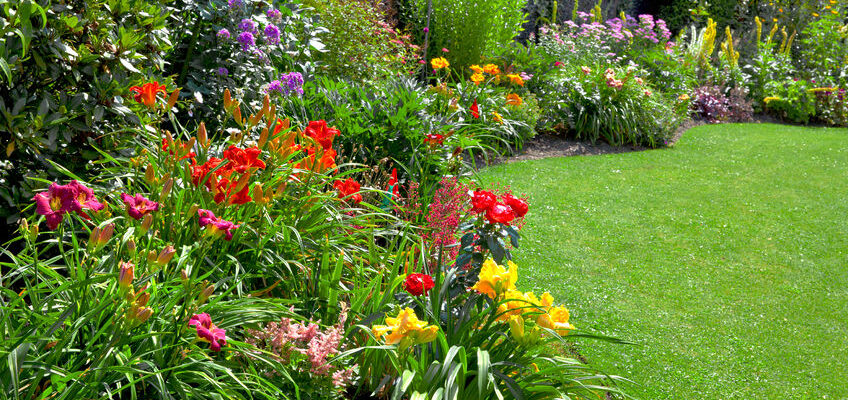
It is difficult to imagine a garden without a flowerbeddon't you think? Although we can create hedges and plant isolated plants, such as a tree, nothing is better than a well-stocked flowerbed that decorate and structure a garden, beautifying it.
If you don't lack the desire to create flowerbeds, this one can quickly become a headache because of all these questions to ask: where to place them? What size should they be? What shapes should they have?
Especially because we need to answer these questions before we even start choosing plants. In fact, and this is a principle to be scrupulously respected, we always design our beds before choosing the plants that will make them up.
Doesn't that seem logical to you? Imagine: How do you know whether to get sun-loving or shade-loving plants if you don't know where your flower bed will be? Or how many plants should you buy if you don't know the size of the flowerbed that will house them?
This design phase is essential for the success of your flowerbeds.
To help you I will explain how to design flower beds that will add real value to your garden.
Where to place flowerbeds in your garden?
There are a multitude of possibilities, why In addition to decorating, a flowerbed can also have other uses.
To highlight your voice
You will find a privileged place to install your flowerbeds between the sidewalk and the main facade of your house. They will do it instantly your welcoming entrance.
This is all the more important as it is a passage that you will use every day to leave and return home, whatever the season and weather.
Imagine coming home after a hard day at work: isn't it pleasant to pass by a flowery and cheerful entrance?
To enhance your home
You can place flowerbeds along the facades of your home. This will highlight your home.
The other advantage of this location is that it is difficult to grow grass up to the edge of the walls due to the overhang of the roof. With a flowerbed you don't have this problem, just place the plants a few tens of centimeters from the edge of the construction.
A little tip that is important: if asked lumps under the windowsyou will have to remember, when choosing the plants, to make sure that they are not too tall so as not to obscure the openings and prevent the shutters from closing.
To hide the borders of your land
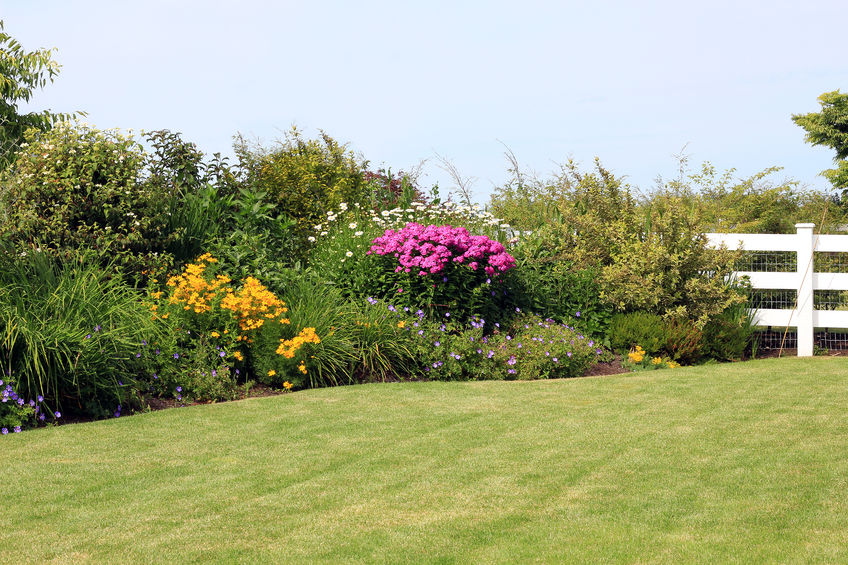
The boundaries of a plot of land are often delimited by a fence, a wall or even a hedge. These are long elements that are visually imposing. You can reduce their visual impact by placing flower beds along your garden.
This will at the same time allow you to partially or completely hide your surroundings your land which will then appear bigger!
You can extend the flowerbed along the entire contour of your property or opt for multiple flowerbeds, positioned punctually.
You also have the option of placing a set of plants the corners of your garden to reduce its very straight appearance.
To highlight a corridor or staircase
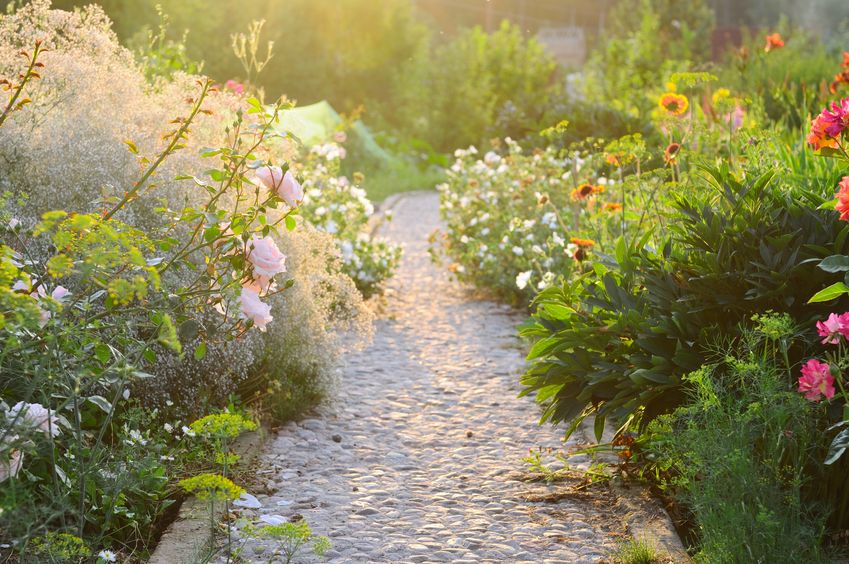
If you want highlight your paths and stairs, place flowerbeds on both sides of these is a good solution.
When choosing and planting plants, make sure they don't spill too much onto the path at the risk of making it difficult to use. An alley remains an alley, we must be able to use it easily!
To delimit spaces
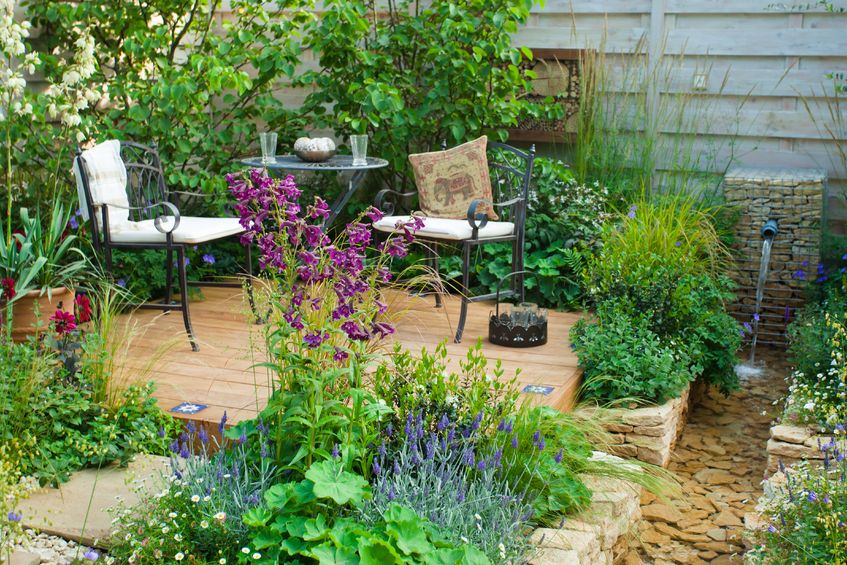
We are used to using hedges to delimit spaces, even within a garden. Well, we can do the same thing with flower beds.
Often the height of these does not allow such a clear masking as with a hedge, but this is an advantage! We hide a part of the garden suggesting that it exists and this makes you want to go there.
You can, for example, demarcate a rest area suitable for relaxing activities such as reading or taking a nap in your garden, all a little away from the rest of the land.
This can also be to separate the vegetable garden. A flowerbed leaning against the latter will create a harmonious connection between the garden of pleasure and the garden of nutrition.
If you have a long terrainflower beds positioned in the direction of the width of the garden will allow this divide it into multiple spaces and break the corridor effect.
Where it is difficult to lay grass
Once you have positioned all the elements that compose it in your garden: terrace, vegetable garden, shelter, swimming pool… the rest of the space is occupied by lawn and flowerbeds.
Some places are not suitable for grass because mowing will be difficult there. This is the case of small areas or even embankments, where it would be dangerous to pass with a lawnmower. Under these conditions, flower beds can be a good alternative. Maintenance, in fact, is less: just carry out annual pruning of some plants and carry out weeding, which can be greatly reduced with mulching.
For embankments, do not hesitate to favor ground cover plants that will spread out and cover the space.
Now you can see more clearly where you can place flowerbeds on your land.
And as you can see, you have a choice!
I will let you choose the location of your future flowerbeds in your garden and then I will tell you about their shapes.
What shapes for your flowerbeds?
If we can absolutely give the flowerbeds the shape we want, we must however respect some rules to have an aesthetic result and transversal coherence throughout the garden.
In fact, tracing the contours of your flowerbeds it depends on the style you have given or want to give to your layout.
If you have organized your land in a modern spiritdesign, with clean lines, the shape of your flowerbeds should remain in this spirit of sobriety geometric shapes.
If you are looking instead a rather natural or rural atmosphereyou will be able to use irregular lines and curves.
But be careful not to do anything: the rounded must be light. If you make the waves too pronounced, the effect won't be pretty.
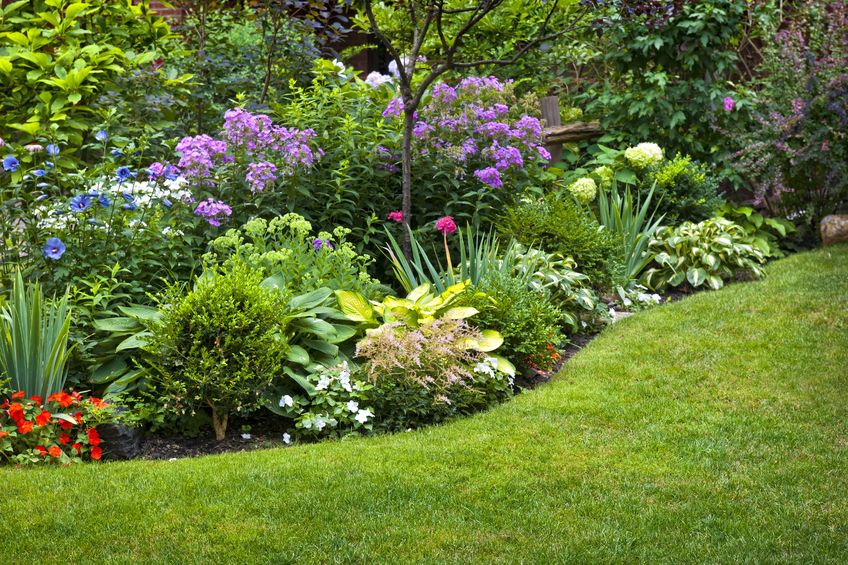
These tips apply to flower beds that have at least one side in contact with the grass, for which you can freely choose the shape to give it.
If your flowerbed is located between two buildings, for example between a driveway and a wall, it will necessarily follow the path of these elements.
At this point you should have a more precise idea of your arrangements. Now you know if you want to create beds with geometric lines, or rather with more natural-looking contours. We have yet to determine the size of each of them.
Dimensions
As I mentioned previously, the lawn and flowerbeds must share the surface which is unoccupied when the rest of the garden is landscaped.
The size of your flowerbeds will therefore depend on the distribution of the lawn compared to the plantings.. You have to take into account two parameters:
- The practical side : Some outdoor activities may require grass. For example, if you have children who want to play outdoors, or if you want to keep some space available to later install a swimming pool. It is therefore necessary to reserve a sufficiently large area of lawn to easily practice these activities and for your facilities. The rest can be piled up.
- The aesthetic aspect : The more bed surfaces you create, the more opulent you will have an effect on the flowering and foliage volume of your plants. Is this what you are looking for? So don't hesitate, plant, plant, plant! If, however, you want to keep large spaces clear for a more airy effect, you will have to maintain nice grassy areas. You see, it's a question of balance and personal taste.
To make your choices, you need to take note of the location, outline and size of each massif. To do this, you have two options:
- If you have a floor general of your garden, you can draw your flowerbeds on it. Nothing stops you from doing several tests before opting for the final version.
- Otherwise you can too represent directly on the ground, materializing its contours using a garden hose, string or even spray paint. Adjust the limits until you get the size and shape that's right for you for each bed.
There you have it, your flowerbeds are designed!
And now the plants!
Thanks to these different steps you have designed your beds. You know how many you will have, where they will be installed, their contours and their dimensions.
You are ready to choose plants who will compose them.
To do this, you will have to take into account the composition of your soil, the climate and the amount of sun in each location of the massif. Remember to select the varieties ensuring a succession of blooms, this is essential to have a flower garden all year round. Finally, it will be necessary to see the arrangement of all these plants in order to obtain an optimal result.
A great program! I'll explain how to do it on this page.
latest posts published

Guide to choosing the right size
Ideal ratio for a high performance engine

Easy installation and practical advantages

How to use sodium bisulfate in a swimming pool: dosage and precautions
Use it correctly for optimal maintenance
The best ideas for an elegant look

Advantages and limitations of this natural coating
How to choose and install your curtains

Materials and advice for better insulation