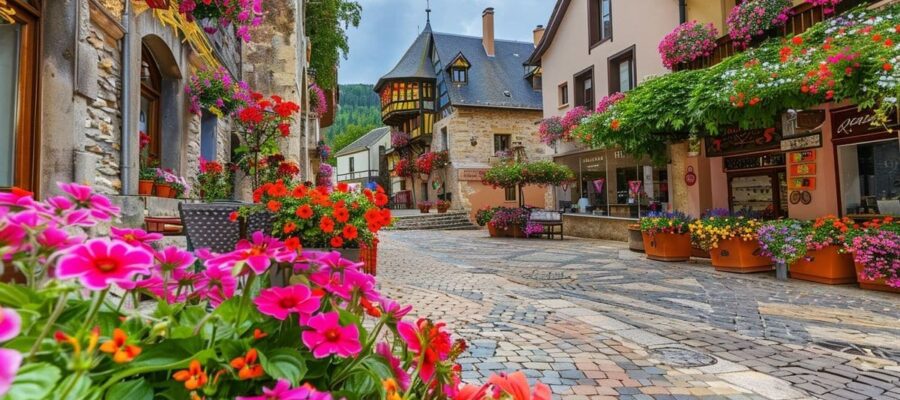
18th-century architecture marks an important transition from exuberant Baroque to rigorous neoclassicism, influenced by archaeological discoveries and republican ideals. This period saw the emergence of hybrid styles, such as baroque poufmixing European motifs and local traditions. In Europe, neoclassicism established itself as a movement back to antiquity, inspired by the excavations of Pompeii and Herculaneum.
Transition from Baroque to Neoclassical
The 18th century began under the influence of Baroque, characterized by dynamic curves and opulent decoration. However, since 1750, a current neoclassical develops favoring simplicity, symmetry and Greco-Roman references. This movement, led by architects such as Claude Nicolas Ledoux and Étienne-Louis Boullée, sought to express political and moral ideals.
Influence of Greek and Roman antiquity
The architects were inspired by the classical orders (Doric, Ionic, Corinthian) and pure geometric shapes. Buildings like theTriumphal arch in Paris or Lincoln Memorial in the United States they embody this search for greatness and political legitimacy. In America, the federal style by Thomas Jefferson, inspired by Palladio, blends classicism and democratic ideals.
Iconic architectural features
The architecture of the 18th century is distinguished by a proportional rigorof classic elements reinterpreted and one spatial hierarchy marked.
Symmetry and geometric order
The facades are organized around a central axis, with aligned windows and triangular pediments. This symmetry, visible in buildings such as the Dolmabaçe Palace in Istanbul, reflects a search for harmony and rationality.
Using classic orders
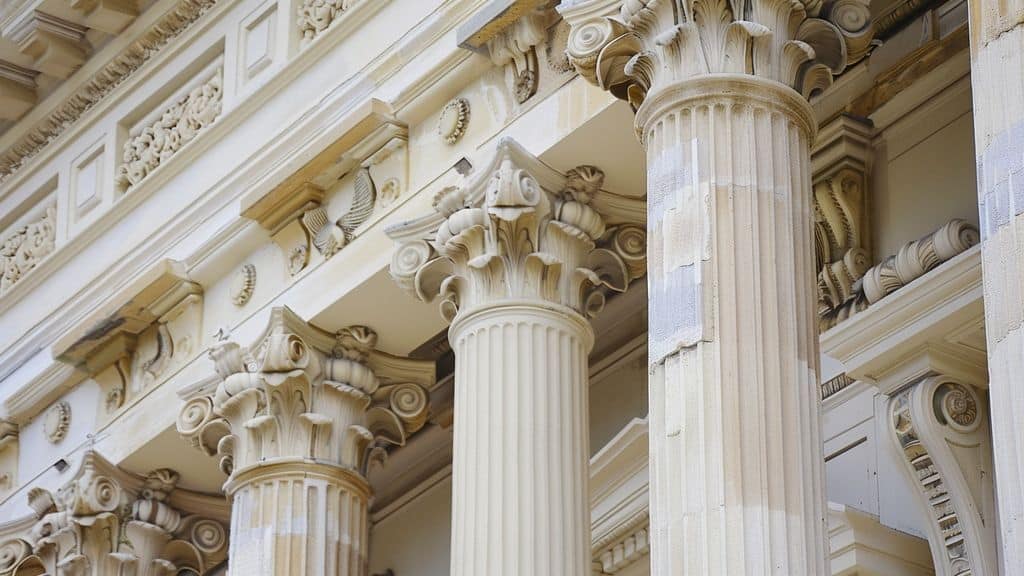
The columns, porticoes and entablatures become structuring elements. THE Greek Revival The American, for example, prefers Doric columns without a base, while the Empire style integrates neoclassical motifs into luxurious decorations.
Innovative materials and techniques
Marble, cut stone and terracotta tiles (like those in Tiled pavilion in Istanbul) are used for their durability and aesthetics. Ottoman architects also experimented with vaulted structures and massive substructures to stabilize buildings.
Inspirations for contemporary projects
The principles of the 18th century offer avenues for modern designs, combining them lightness et solemnity.
Reinterpretation of classic models
Architects can integrate simplified neoclassical elements (columns, pediments) in contemporary design. THE stripped classicismpopularized by government buildings, it shows how to combine modernity and historical references.
Balance between functionality and aesthetics
Spaces designed for specific uses (such as living rooms in private homes) can inspire current interior designs. Noble materials (wood, marble) and harmonious proportions remain points of reference for luxury projects.
Integration of symmetry and hierarchy
In public projects (museums, libraries), a axial symmetry and one volume hierarchy (as in Brooklyn Museum) create an impression of grandeur and solemnity.
Main examples and case studies
Several buildings embody the innovations and contradictions of this era.
Dolmabaçe Palace: Ottoman eclecticism
Built in the 19th century, this palace mixes neoclassicism, baroque et oriental elementswith large halls and gold details. Illustrates the opening of the Ottoman Empire to European influences.
The Lincoln Memorial: American neoclassicism
This Doric temple, inspired by the Parthenon, symbolizes democratic ideals. Its massive structure and Lincoln inscriptions make it an emblematic monument of the neoclassical style adapted to the national identity.
The pavilions of Mehmed II: stylistic experimentation
In Istanbul, three pavilions built under Muhammad II (Ottoman, Greek, Persian) show a multicultural experimentation. THE Tiled pavilionwith its Iranian tiles and its cruciform vault, it embodies this hybridity.
Technical challenges and innovations
Eighteenth-century architects had to overcome technical and economic challenges to realize their visions.
Hardware limitations and creative solutions
The use of massive substructures (as at Topkapi) allowed buildings to be stabilized on unstable ground. Terracotta tiles, less expensive than sculpture, offered a decorative alternative.
Economy of means and classicism reduced to the essentials
THE stripped classicismadopted by authoritarian regimes, it reduced costs by eliminating unnecessary ornaments. Buildings like theGerman embassy in St. Petersburg (Peter Behrens) are examples.
Influence of travel and cultural exchanges
They introduced Ottoman architects, such as those of the Balyan family European elements (like neoclassical models) in their creations, creating a unique style.
Heritage and modern reinterpretation
The 18th century continues to inspire contemporary architects, particularly in institutional and cultural projects.
Reappropriation of classical forms
Buildings like the Lincoln Center (Philip Johnson) or the National Library of Australia reinterpret the columns and pediments in a modern language. These results highlight the sustainability of classical ideals.
Integration in urban policies
Cities like Paris or Washington use neoclassical references to anchor their institutions to a context common history. 18th-century palaces, with their modular living rooms, offer models for today's public spaces.
Contemporary issues: between tradition and innovation
If neoclassicism remains associated with authoritarian regimes (such as Nazism or Stalinism), democracies also support it as a symbol of stability and the legitimacy. This ambivalence reflects the tensions between heritage and modernity.
The architecture of the 18th century, between baroque and neoclassicism, offers a rich repertoire for current projects. Its principles of symmetry, noble materials and historical references allow the creation of functional and symbolic spaces. By reinterpreting these elements, contemporary architects can reconcile tradition et innovationhonoring a heritage that transcends the ages.
latest posts published

Guide to choosing the right size

Ideal ratio for a high performance engine

Easy installation and practical advantages

How to use sodium bisulfate in a swimming pool: dosage and precautions

Use it correctly for optimal maintenance

The best ideas for an elegant look
Advantages and limitations of this natural coating
How to choose and install your curtains

Materials and advice for better insulation