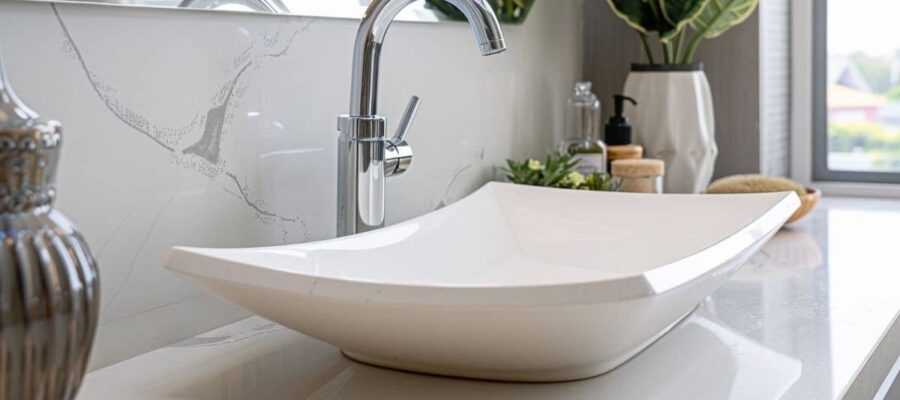
Material choices for kitchen sinks are constantly evolving, with quartz and granite vying for first place. These two options, although distinct, satisfy specific needs in terms of aesthetics, practicality and longevity. Decipher the advantages and disadvantages of each material to guide your choice.
Design and customization
Variety of colors and finishes
THE quartz stands out for its wide range of colors and its sophisticated visual effects. Unlike granite, whose natural patterns vary depending on the blocks mined, quartz offers a color uniformity and imitations of precious stones (marble, onyx) using advanced manufacturing techniques. For example, the Silestone Eternal Marquina reproduces the marbled effect with unrivaled regularity, ideal for a modern kitchen.
THE granitefor his part, he focuses onauthenticity of its natural veins, offering an organic and unique touch. Models like the Primagran Copenhagen in black or white granite exploit this peculiarity to create dramatic contrasts.
Integration into kitchen styles
Quartz is particularly well suited to contemporary kitchens thanks to its smooth and refined finishes. White or black models, like those proposed by IKEA and quartz compositebrings a minimalist and elegant touch. On the contrary, granite fares better warm atmospheres or rustic, especially in kitchens made of wood or natural stone.
Care and maintenance
Daily cleaning
THE quartz radically simplifies maintenance thanks to its non-porous surface. To remove food residues, a simple damp cloth is sufficient, unlike granite, which requires specific products to avoid stains. This ease of maintenance is particularly appreciated in active families, as demonstrated by the experience of Julie and Pierre, who chose quartz for its resistance to coffee or wine stains.
THE granite requires a regular sealing (every 1 or 2 years) to protect its porosity. Without this treatment it risks deteriorating if exposed to oils or acids. Granite sinks, like those of Primagranthey therefore require more rigorous maintenance.
Impact and scratch resistance
Quartz reveals itself more resistant to impacts thanks to its composition of resins and synthetic crystals. The models inside black quartz composite from IKEA resist extreme heat and scratches, even with metal utensils.
Granite, although hard, can crack under violent impacts. Its shiny surfaces are also more sensitive water markswhich require frequent cleaning to preserve their shine.
Sustainability and long-term investments

Wear resistance
THE quartz outperforms granite sustainabilitywith a longevity from 20 to 30 years without complex maintenance. Its compact design limits the risk of discoloration or damage, even in heavily used kitchens.
THE granitealthough robust, it can wear out over time, especially if its sealing is neglected. White or black granite sinks Castorama require greater vigilance to avoid permanent stains.
Initial cost and long-term savings
Quartz is generally more expensive (from 300 to 600 €/m² versus 200 to 400 €/m² for granite). However, his no maintenance costs reduces long-term costs. The models inside quartz composite from IKEA, starting from €129, they offer an interesting quality-price ratio for limited budgets.
Granite, although less expensive to purchase, generates recurring expenses (sealing, cleaning products). Granite sinks Primagransold between €149.99 and €269.99, they represent a moderate investment, but provided that rigorous maintenance is respected.
Use cases and recommendations
For modern and busy kitchens
THE quartz it is essential for families seeking practicality and elegance. Son marbled effect (like Silestone Eternal) or his own clean design (white quartz) fits perfectly into minimalist kitchens. The models inside black quartz composite from IKEA, impact resistant, suitable for large families.
For lovers of authenticity
THE granite appeals to those who are in favornatural look. White or black granite sinks Castorama add an organic touch to rustic or traditional kitchens. However, this choice implies a greater vigilance to preserve their condition.
Conclusion: make the right choice
THE quartz and the granite satisfy distinct needs. Choose quartz if you are looking durability, ease of maintenance and aesthetic uniformity. I prefer granite for a natural touch and unique customizationaccepting a more demanding interview. Whatever your choice, choose reliable brands (Silestone, Primagran, IKEA) to ensure quality and longevity.
Conclusion
Choosing between quartz and granite for a kitchen sink ultimately depends on balancing aesthetics, practicality, and long-term performance. Both materials offer premium qualities, but they cater to slightly different expectations and lifestyles. Understanding their strengths and limitations is key to making an informed decision that aligns with your daily needs and design preferences.
Quartz sinks are highly valued for their modern appearance and uniform finish. Engineered from natural stone combined with resins, they provide excellent resistance to stains, scratches, and impacts. Their non-porous surface makes them particularly hygienic and easy to maintain, as they do not absorb liquids or odors. This makes quartz an ideal choice for busy kitchens where convenience and cleanliness are priorities. Additionally, the wide range of colors and finishes allows for greater customization, helping homeowners achieve a cohesive and contemporary look.
Granite, on the other hand, stands out for its natural authenticity and timeless appeal. Each sink is unique due to the natural variations in the stone, offering a more organic and elegant aesthetic. Granite is extremely durable and heat-resistant, making it well-suited for intensive use. However, depending on the finish, it may require more careful maintenance, such as periodic sealing, to preserve its resistance to stains and moisture. Despite this, many users appreciate its robustness and the character it brings to a kitchen space.
In the end, there is no universally “better” option—only the one that best fits your priorities. If you value low maintenance, consistency, and modern design, quartz may be the right choice. If you prefer natural beauty, uniqueness, and long-lasting strength, granite could be more suitable. By carefully considering how you use your kitchen and the level of maintenance you are willing to commit to, you can confidently select a sink material that combines style, functionality, and durability for years to come.
latest posts published

Guide to choosing the right size

Ideal ratio for a high performance engine

Easy installation and practical advantages

How to use sodium bisulfate in a swimming pool: dosage and precautions
Use it correctly for optimal maintenance

The best ideas for an elegant look
Advantages and limitations of this natural coating
How to choose and install your curtains
Materials and advice for better insulation