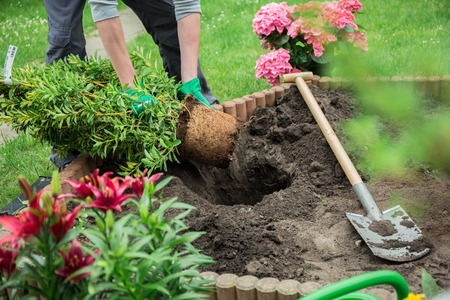
You decided to do it create your own garden. Bravo!
You'll see, it's a very rewarding adventure. You will discover techniques called “ landscape creation » and we must admit that it is very complete: creating your terrace, working perhaps with wood or stone, creating walls, arranging the flowerbeds and planting, sowing the grass, installing various equipment… All this is fascinating, you learn many things during all the work you are going to do!
And in the end you will be able to enjoy sunny days in your garden. You will also have the pride of inviting your loved ones by explaining this to them you did everything yourself, from A to Z. How beautiful satisfaction!
Probably when you started imagining your ideal garden you made two observations: It will cost money and take time. But that didn't discourage you. You will make your layout at your own paceduring weekends and your holidays, and at the pace of your financeswhile you put money aside. And so, the work will take place in several phases and will probably extend over several months, if not even several years.. Rest assured, anyone who creates their own garden goes through this.
However, there are some precautions to take because mistakes happen quickly. Among the most common pitfalls: lack of coherence. That is, building your garden piece by piece without thinking about the final overall layout and realizing that not everything goes together and that the garden is not harmonious.
There is also the risk offorget things and to realize it when it will be too late, when there will be no more space. Or perhaps worse, wanting to place the missing equipment at all costs and finding yourself with an impractical layout.
Or again, be poorly organised and in the end, spend more than expected…
In short, you may encounter some obstacles that can undermine your motivation, slow down the progress of your project, and cause you to lose money.
To save you these worries, I have listed 7 rules to follow. This way you will be sure to do it succeed in your gardeneven if you are doing the work in stages.
1. Create a plan
If there's one rule you need to remember, it's this: you must take the time to make a plan of your garden before starting work, it is essential.
- He is your guarantee so as not to forget anything. Everything you have thought of for your garden will be on the plan, it is impossible to leave anything out.
- He will let you orient yourself more easily in your progresst: you know what you have already done and what remains to be done. When the job spans several months, it is a necessity and a time saver.
- Six sure of the final result. You know what your garden will look like once the work is finished, even if it took several years to get there. And you will be able to verify even before giving the first stroke of the spade that everything is positioned in a practical way.
2. Define a style
I mentioned it before, one of the biggest risks when you create your garden gradually is not having coherence between the different parts and therefore not obtaining a harmonious result.
To avoid this, you need to define a style for your garden and use it for all aesthetic choices.
You have two ways to organize yourself :
- OR define everything from the beginningthat is, when you make your project, choose all the equipment and materials that will go into the garden according to the style you have determined.
You then make your purchases as you complete the job. I think this is the best way to do things: we take the time to think about it at the beginning, then when we start the work we no longer have questions to ask ourselves. - In both cases, define the general lines of your layout when creating the plan and you will make specific choicessuch as the model of the tool shed or the terrace cover, as the work progresses. The advantage is that you can make your selection based on current promotions or that you can more easily find your favorites as you discover them.
In this case you will always have to think carefully when making your choices respecting the style you have defined.
3. Define an order in the works
Among the questions that must be running through your mind is certainly: where to start? Which job should I do first? What order should I follow?
I think it's different for everyone. Simply ask yourself: What solutions do you consider priorities?
For example, if you have a dog and want to let it run around in the garden, the first thing to do will probably be to fence it off.
It is also very common to start from the terrace because it will allow you to eat outdoors, even if the garden is not finished.
So it all depends on you and your priorities.. Start with the work that seems most important to you in relation to the activities you will carry out in your garden.
So, be careful to maintain a a certain logic in your order, i.e Don't start with something that will hinder the rest of the workor which could be damaged or even destroyed.
I am thinking in particular of the lawn which is usually done last because the passage of cars and the delivery of materials risk damaging it. If a lawn is essential for you right from the start, for example for your children to play on, do it in parts. When you know that a part of your garden is finished and you won't have to go over it with a machine or vehicle, lay the grass only on that part.
Eventually, progress will too It depends on your budget. What adjustments can you make with the money you currently have?
So make a list of jobs based on your priorities and in a logical order, then do them according to your finances.
Nothing stops you from putting multiple jobs in the same order and you will choose to do one first rather than the other depending on the budget you have at that moment.
As you can see, good organization is essential and the next four rules are related to this.
4. Make a plan
Making a plan can be a huge advantage for the correct execution of the work.
I'm not asking you to plan the entire garden day by day. This would be impossible because we don't always know exactly how much working time each activity represents, but above all it would not take into account your personal unforeseen circumstances, as well as the vagaries of the weather that may prevent you from carrying out certain jobs.
However, Give yourself deadlinesfor example: «at the end of this month, I must have completed this task», can help you make good progress on a regular basis.
It is also a necessity because some jobs have seasonal needsin particular everything that concerns vegetation: planting and creating lawns cannot be done all year round. A program will be useful to you so as not to forget these tasks which, if they are not done in spring, you will have to wait until the following autumn, with the disadvantage of leaving you with a garden without plants for the whole summer.
The program will even let you do that Get organized for your purchases. Some materials may only be available to order in store with a delay of several weeks.
5. Group jobs that require the same equipment
If you need to rent a specific car to accomplish a task, ask yourself if you can't do other things at the same time.
For example, you rent a mini excavator to build the foundation of your terrace, which is the next development you want to make.
You can take advantage of this to dig your future pond, ditches to pass the electrical pipes for the lighting system, etc. Even if you don't do these plans right away, at least the land preparation will be done, you won't need to rent a mini excavator again later with the costs that entails.
In the meantime, it will be sufficient to secure the holes and ditches you have made, for example by surrounding them with a temporary fence.
6. Group purchases of the same material
In a garden, it's beautiful find the same material in multiple placesthis helps create continuity between the elements.
For example, you have chosen a model of slabs for your terrace and you want to use the same ones for the path that goes around the house and connects this terrace to the entrance.
In this case it is better to purchase the quantity of tiles needed for the patio and the driveway at the same time, even if you plan to carry out these works at two different times. There is two reasons to this:
- The cost : The greater the quantity of material you purchase, the more you are able to negotiate the price. In large DIY stores this is not always easy, but in hardware stores it is doable.
In all cases it is a saving for delivery which often takes place in the form of a parcel. - The aesthetics : if you buy the same material months later, you risk finding yourself with slabs from two different productions and there is a very high risk that the tub will not be the same, i.e. that there will be a slight difference in colour. Now in the example I gave you, if the slabs of the terrace and those of the path do not have exactly the same color, this will be seen at the point where they meet.
7. Think about access
You will see during the creation of your garden that it is necessary to constantly pass and carry things: travel with a car, have materials delivered as close as possible to the place where you will use them, etc.
If you start by creating your own fence and because of this access to your garden becomes limited, this will complicate the completion of the work.
We must therefore always think maintain easy access to places where work still needs to be done.
This doesn't stop you from building the fence, but make sure it can be easily detached. Or, if one of the posts prevents the passage of a slightly large car, do not set it in the concrete from the beginning, but simply push it into the ground. You can easily remove it as needed, and once all your yard work is complete, you can seal it permanently.
As you understood, much of the success of your garden requires a phase of reflection and organization. You need to take the time to prepare your project and work. This will save you a lot of disappointment and save you where you are going!
Now, if you already have the project for your garden in hand, check that you have respected the first two rules. Then organize your work following the other rules and everything will be fine.
On the other hand, if you don't know how carry out your plancomment set the stylecomment Don't forget some items for your garden, like organize your budgetcomment choose the materials for your various jobs… discover my method «The 5 steps to successfully set up your garden», everything is explained step by step.
This will make your work easier and guide you in your choices. You will move forward more quickly with your project knowing you won't make any mistakes. It won't be a headache anymore, it will just be fun! And in the end you will be sure to have the garden you like.

latest posts published

Guide to choosing the right size

Ideal ratio for a high performance engine

Easy installation and practical advantages

How to use sodium bisulfate in a swimming pool: dosage and precautions

Use it correctly for optimal maintenance

The best ideas for an elegant look

Advantages and limitations of this natural coating

How to choose and install your curtains

Materials and advice for better insulation